Blog
GymsReplace Free Trials With a Controlled Lead System
Published 2025-12-19
It is Monday morning. You check the sign-up sheet from last week’s free trial promotion. Fourteen people came in. Three used the equipment for twenty minutes and left without talking to anyone. Four walked around, took a selfie, and never came back. Five said “I will think about it” and vanished. Two actually joined.
Two out of fourteen. And you ran that promotion for an entire week, printed flyers, posted it on social media, and had your front desk staff explain the offer probably a hundred times.
Free trials are the gym industry’s sacred cow. Everyone offers them. Everyone assumes they work. And almost nobody tracks whether they actually convert into paying members.
Let me save you the trouble: they mostly do not.
The free trial trap
The average free trial conversion rate for gyms sits between 15% and 20%. That means for every 100 people who walk through your door for a free workout, 80 to 85 of them will leave and never pay you a cent.
Think about the cost of those 80 people. Your staff greeted them, showed them around, answered their questions, cleaned up after them, and managed the extra load on your equipment. Your trainers may have spent time with them. Your facility was busier, which may have impacted the experience for your actual paying members.
Free trials are not free. They cost you time, attention, and resources. And they attract a specific type of person: someone who is motivated by the word “free,” not by the word “fitness.”
This is not a knock on people. It is human nature. When something has no cost, it has no perceived value. And when something has no perceived value, there is no commitment. No stakes. No reason to show up the second time.
What a “qualified” lead looks like
Now compare that to a different number. Gyms that use a pre-qualification process before the first visit convert at 45% to 60%. Not a typo. Forty-five to sixty percent.
That is three to four times better than the free trial approach. And the cost per acquisition drops by roughly 40%, because you are spending your team’s time and energy on people who are actually ready to commit.
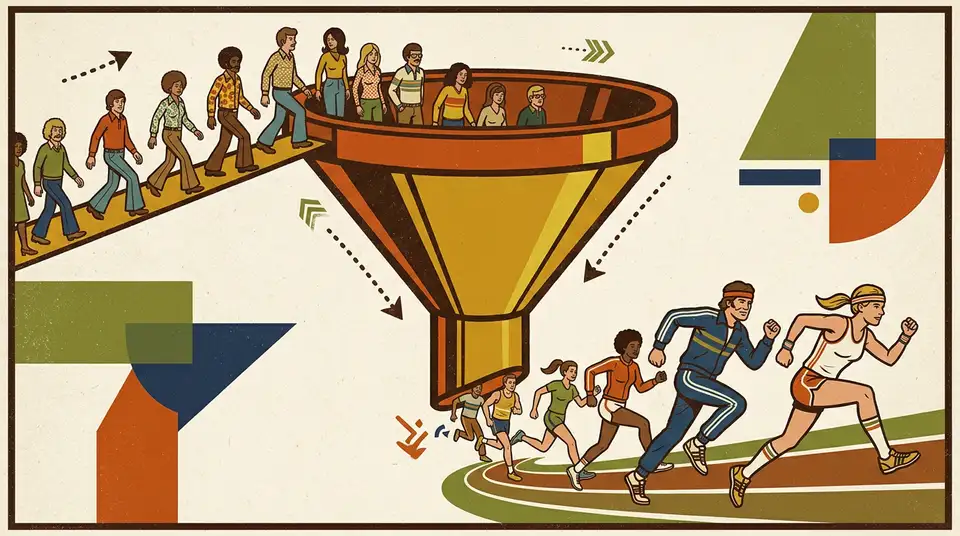
The difference is not magic. It is filtering. Instead of opening your doors to everyone and hoping the right people show up, you design a process that attracts committed people and screens out tire-kickers before they ever walk through your door.
The psychology behind the switch
Here is why pre-qualification works, and it comes down to something simple: effort equals commitment.
When someone fills out a form that asks about their goals, their experience level, and when they are available — they are investing. Not money, but attention. They are thinking about what they want. They are imagining themselves training. They are already mentally placing themselves in your gym.
By the time they show up for their first visit, they have already made a small commitment. And small commitments lead to bigger ones. This is not a sales trick. It is how human decision-making works. Psychologists call it the consistency principle: once someone takes a step in a direction, they are far more likely to keep going.
A free trial asks for nothing. A Personal Fitness Assessment asks for thought, time, and intention. The people who provide those things are the people who become members.
The fix: from “Free Trial” to “Personal Fitness Assessment”
Here is how to make the switch. You do not need new software. You do not need to hire anyone. You need a landing page, a form, and a process.
Step 1: Change the language
Stop saying “Free Trial.” Start saying “Personal Fitness Assessment” or “Your Custom Training Plan” or “Free Strategy Session.”
The word “trial” implies browsing. The word “assessment” implies expertise. You are not letting people test-drive your treadmills. You are offering them something valuable — a professional evaluation of where they are and a roadmap for where they want to go.
This is not just a rebrand. It changes who responds. The person looking for a free workout skips past the word “assessment.” The person who actually wants to get in shape leans in.
Step 2: Build a qualification form
On your landing page (not your homepage — a dedicated page designed for this one purpose), place a form that asks four questions:
What is your main fitness goal? Give them options: lose weight, build muscle, improve endurance, general health, sport-specific training.
What is your current experience level? Options: complete beginner, some experience, regular gym-goer, advanced.
What days and times work best for you? This tells you when to schedule the visit and shows you have structure.
What has stopped you from reaching your goals before? This is the power question. It tells your trainer exactly what to address during the assessment, and it forces the prospect to articulate their own obstacles. That self-awareness is the foundation of commitment.
Four questions. Takes 90 seconds to fill out. And it gives you everything you need to deliver a personalized experience.
Step 3: Personalize the response
When someone submits the form, do not send a generic “Thanks, we will be in touch.” Send a response that reflects what they told you.
“Hi Sarah. Based on your goals — building strength as a beginner — I have booked you with Elena, who specializes in exactly that. Your Personal Fitness Assessment is set for Thursday at 5:30pm. Elena will have a plan ready for you. Just bring comfortable shoes.”
Now Sarah has a name, a time, a trainer who matches her goals, and a reason to show up. She is not “trying out a gym.” She is starting something.
Compare that to: “Come by anytime during open hours for your free trial!” One creates momentum. The other creates maybe-laters.
With the AI layer wired in, this personalisation is automatic. A workflow reads the form responses, picks the trainer whose specialty best matches the prospect’s goal, and drafts the confirmation message in your gym’s voice. Your front desk reviews the draft for 20 seconds, taps approve, and the prospect gets a personal-feeling reply within minutes of submitting — even if you’re in the middle of a class.
Step 4: The assessment itself
When Sarah walks in on Thursday, Elena already knows her name, her goals, her experience level, and what has held her back in the past. Elena does not need to do a generic tour of the weight room.
Instead, Elena spends 30 minutes doing a real assessment. Basic movement screening. A conversation about Sarah’s daily routine and schedule. A brief walkthrough of the specific equipment and classes that match her goals.
At the end, Elena hands Sarah a simple printed sheet — or sends a message — with a suggested weekly plan. “Here is what your first month looks like. Monday strength with me, Wednesday a group class, Friday cardio on your own. You will see measurable progress in four weeks.”
This is not a sales pitch. This is a professional delivering professional value. And that value is what makes the next conversation natural.
Step 5: The close happens naturally
After 30 minutes of personalized attention and a custom plan, Elena says: “Ready to get started? I have your Monday slot open starting next week.”
That is it. No pressure. No discounts. No “but if you sign up today…” gimmicks. The value has already been demonstrated. The relationship has already started. The prospect is not deciding whether to join a gym. They are deciding whether to continue something that has already begun.
This is why conversion rates double and triple with this approach. You are not closing strangers. You are continuing a conversation with someone who already told you what they want and saw that you can deliver it.
What this looks like on your website
Your website is the entry point for this entire system. The landing page for your fitness assessment needs to do three things well.
First, it states the outcome, not the feature. Not “Free Trial at [Gym Name].” Instead: “Find Out Exactly How to Reach Your Fitness Goal — Free 30-Minute Assessment with a Certified Trainer.”
Second, it shows social proof. A testimonial from someone who went through the same process. “I came in for the assessment not sure if I would join. Elena had a plan ready for me before I even finished changing. Three months later I’m down 8 kilos.” Real name, real photo if possible.
Third, the form. Four questions, big buttons, works perfectly on a phone. No email required at this stage — just name, phone, and the four qualifying questions. You can collect email later.
Below the form, a short FAQ. How long does it take? (30 minutes.) Is it really free? (Yes, no obligation.) What should I bring? (Comfortable clothes and shoes.) Do I need experience? (No, we work with all levels.)
That is the whole page. One goal, one path, one action.
The system view
Free trials are a legacy idea from when gyms competed on price and equipment. You had to let people “try before they buy” because there was no other way to demonstrate value.
That era is over. Today, you can demonstrate value before someone ever walks through your door. Your website shows your expertise. Your form shows you care about their specific situation. Your personalized response shows you are organized and professional. Your trainer’s preparation shows you deliver on your promises.
By the time the prospect arrives, the selling is already done. What remains is just confirmation — seeing in person what they already felt online.
This is the difference between a gym that chases everyone and a gym that attracts the right people. One is exhausting and expensive. The other is sustainable and profitable.
Your pipeline is not: advertise, give stuff away, hope they sign up. Your pipeline is: attract the right attention, qualify interest, deliver value, make the next step obvious.
The gyms that grow are the ones that stopped giving away free workouts and started building systems that convert the right people at the right time. You do not need more foot traffic. You need better foot traffic. And that starts with the very first question you ask.