Blog
What to Track Before Spending More on Ads
Published 2026-07-12
Buying more ads is tempting because it feels like action.
Bookings are slow? Run ads.
The gym needs more members? Boost a post.
The spa has quiet weekdays? Promote a package.
The real estate team needs more buyers? Spend more on lead campaigns.
The clinic wants more consultations? Push traffic to the website.
Sometimes ads are the right move. But most small businesses spend more before they know where the current traffic is leaking.
That is expensive.
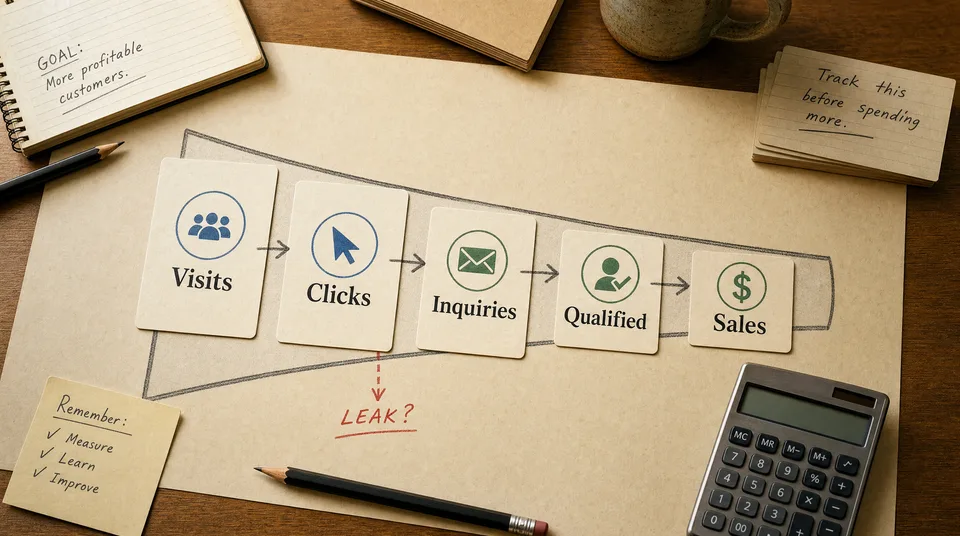
If 1,000 people visit your website and only 3 inquire, more traffic may give you more leads. It may also multiply the same leak. Before increasing the ad budget, track the path from visitor to real inquiry.
You do not need a complicated analytics setup. You need five numbers and a habit of looking at them.
The simple funnel
For most small businesses, the website funnel looks like this:
- Visit
- Key page view
- Action click
- Inquiry or booking
- Qualified inquiry
- Sale or confirmed booking
Each step answers a different question.
Visits tell you whether people arrived.
Key page views tell you whether they reached the important page: menu, treatment, program, property, consultation, or class.
Action clicks tell you whether they tried to move forward: WhatsApp, booking, call, form, directions, email.
Inquiries tell you whether the action became a lead.
Qualified inquiries tell you whether the lead was useful.
Sales or confirmed bookings tell you whether the system created revenue.
If you only track visits, you are guessing. If you only track sales, you are learning too late.
Metric 1: visits to the right pages
Total website traffic is less useful than traffic to the pages that matter.
For a restaurant, the key pages are usually the menu, location, and booking page.
For a spa, treatment pages and package pages matter more than the homepage.
For a gym, program pages, trainer pages, pricing, and trial assessment pages matter.
For real estate, individual property pages and neighborhood pages matter.
For a clinic, consultation pages and service pages matter.
For a cooking class, booking pages, market-experience pages, and location-specific pages matter.
Ask:
- Which pages are people actually viewing?
- Are they reaching the page where the decision happens?
- Are ad campaigns sending people to a relevant page or just the homepage?
If a gym ad promotes beginner strength training but sends people to a generic homepage, the tracking will show the problem. People arrive, scan, and leave because the page does not continue the promise.
Fix the landing page before increasing spend.
Metric 2: action clicks
An action click is any click that moves a visitor toward contacting you.
Track:
- Book now
- Call
- Get directions
- Send inquiry
- View availability
- Download menu
- Request consultation
- Schedule viewing
This number tells you whether the page is persuasive enough to create intent.
If 500 people visit a treatment page and only 2 click “Book”, the issue is probably not ad volume. The page may be unclear, the price may be hidden, the treatment may feel generic, or the button may be buried.
If 500 people visit and 80 click “Book”, but only 5 complete the booking, the issue is later in the flow.
Action clicks show where to look.
Metric 3: inquiry completion
Clicks are not leads.
A visitor can click the booking button and still abandon the form. They can tap WhatsApp and never send a message. They can open the inquiry form and stop when they see 14 fields.
Track completed inquiries separately:
- submitted forms
- WhatsApp messages actually sent
- calls from the website
- confirmed booking requests
- consultation requests
- viewing requests
Then compare action clicks to completions.
If 100 people click but only 10 complete, your handoff is broken.
Common causes:
- the form is too long
- the booking tool loads slowly
- the next step opens in a confusing app
- the user has to repeat information
- pricing or availability appears too late
- the form asks for sensitive information too early
A spa that asks for full address, birth date, treatment history, and marketing consent before showing available times will lose people. A real estate form that asks 12 questions before letting someone request a viewing will lose buyers. A gym trial form that feels like a contract will lose beginners.
Shorten the step before buying more traffic.
Metric 4: qualified inquiries
This is the number most small businesses skip.
Not every lead is useful.
A restaurant inquiry for 20 people tomorrow is different from a vague message asking “menu?” A gym trial request from someone ready to start this week is different from someone outside your city. A real estate buyer with matching budget and timeline is different from someone browsing far below the property price.
Track inquiry quality with simple labels:
- hot
- warm
- cool
- mismatch
You do not need complex scoring at first. Just define the labels.
Restaurant:
- hot: date, party size, time, ready to book
- warm: asks about menu or availability
- cool: general question with no date
- mismatch: request you cannot serve
Gym:
- hot: clear goal, local, wants to start within 30 days
- warm: interested but unsure on timing
- cool: browsing prices
- mismatch: location or service does not fit
Real estate:
- hot: budget matches, timeline under 3 months, asks for viewing
- warm: budget close, timeline 3 to 6 months
- cool: early research
- mismatch: budget or property type does not match
Once you track quality, ads become easier to judge. A campaign that creates 50 cheap leads but only 2 qualified inquiries may be worse than a campaign that creates 12 leads with 8 qualified inquiries.
Metric 5: follow-up status
Many small businesses lose leads after the inquiry.
The website worked. The person clicked. They filled the form. They were a good fit.
Then nobody replied for five hours.
Or the first reply was generic.
Or the lead needed a second nudge and never got one.
Track follow-up status:
- new
- replied
- waiting for customer
- booked or scheduled
- lost
- needs follow-up
This is where AI workflows can help without pretending to close the sale.
A workflow can summarize the lead, suggest a label, draft the first reply, and remind the team when no one has followed up.
The owner still approves messages and decides how to handle important leads. The workflow makes the waiting pile visible.
The weekly tracking sheet
Start with a simple table:
| Step | This week | Last week | Notes |
|---|---|---|---|
| Key page visits | |||
| Action clicks | |||
| Completed inquiries | |||
| Qualified inquiries | |||
| Confirmed bookings or sales | |||
| Leads needing follow-up |
Then add one line:
This week's biggest leak:That line matters more than the table.
If the biggest leak is key page visits, your ads or SEO may be sending the wrong people.
If the biggest leak is action clicks, your page is not convincing enough.
If the biggest leak is inquiry completion, your form or booking tool is creating friction.
If the biggest leak is qualified inquiries, your offer or targeting is wrong.
If the biggest leak is follow-up, your team needs a better reply and routing system.
What this looks like across verticals
A restaurant sees 1,200 menu page visits, 180 booking clicks, 60 completed booking messages, and 44 confirmed reservations. That is healthy. More ads might make sense if the restaurant can handle the volume.
A spa sees 800 treatment page visits, 90 booking clicks, and 9 completed bookings. The booking step is leaking. Fix the form before buying more traffic.
A gym sees 400 program page visits, 35 trial clicks, 30 completed forms, and only 4 qualified leads. The page is attracting the wrong people or the offer is too broad.
A real estate agency sees 2,000 property views, 70 inquiries, and 8 qualified buyers. The property pages are creating interest, but the qualifier needs better budget and timeline questions.
A clinic sees 600 consultation page views, 45 call clicks, and no record of call outcomes. The tracking gap is after the click. Staff need a call log or simple intake label.
A cooking class sees 300 booking page views from Germany, 50 availability clicks, and 4 bookings. The content may need better language support, clearer dietary information, or payment reassurance for travelers booking before arrival.
Same funnel. Different business. Same lesson: track the step before guessing the fix.
What AI can do with these numbers
AI does not need to make the decision for you.
It can prepare the weekly summary:
“This week, action clicks were strong but completed inquiries dropped. The biggest leak is the booking form. Most drop-offs happen after visitors choose a date. Review the form length and payment step before increasing ad spend.”
It can flag unusual patterns:
- many WhatsApp clicks, few messages
- high property views, low budget match
- treatment page interest but no package bookings
- strong gym trial forms but slow staff replies
It can draft the next action:
- shorten this form
- move price higher on the page
- add a clearer CTA
- create a better reply template
- split one ad campaign by intent
The owner still decides. The workflow makes the decision easier.
Before you spend more
Use this checklist:
- Do we know which page the ad sends people to?
- Do we know whether visitors click the CTA?
- Do we know whether CTA clicks become completed inquiries?
- Do we label inquiries by quality?
- Do we know how fast we reply?
- Do we know how many qualified leads become bookings or sales?
- Can we name the biggest leak this week?
If the answer is no, more ad spend is premature.
Not always wrong. Just premature.
The point
Ads amplify the system you already have.
If the website is clear, the form is simple, the lead is qualified, and the follow-up is fast, ads can work.
If the path is broken, ads mostly buy more confusion.
Track the path first. Fix the leak. Then spend.
If you want help finding where your website loses inquiries before you put more money into ads, talk to Art of Web.