Blog
RestaurantsBuild a Restaurant That Markets Itself (With 10 Minutes a Day)
Published 2026-02-06
You do not have time for marketing. You are running a restaurant.
Prep starts at 6am. The lunch rush hits before you have finished your coffee. There is a supplier issue to sort out, a staff call-out to cover, and the walk-in fridge is making a noise it should not be making. By the time the dinner service winds down at 11pm, the last thing on earth you want to think about is posting on Instagram.
We get it. And here is the truth: you should not have to think about it.
The real problem is not lack of effort
A 2024 Toast survey found that 60% of restaurant owners say marketing is their biggest challenge. Not food costs. Not staffing. Marketing.
But the problem is not that restaurant owners are lazy or do not care. The problem is that marketing in most restaurants depends on one person remembering to do it. And that person is usually the owner, who already has 47 other things competing for their attention.
So what happens? Monday, you post a nice photo of the special. Tuesday, you forget. Wednesday through Friday, the kitchen is chaos and nobody even thinks about it. Saturday, you feel guilty and post something at 10pm that gets 12 likes. Sunday, you are closed and swear you will be more consistent next week.
This cycle repeats forever. And inconsistent marketing is almost worse than no marketing, because it signals to customers (and to algorithms) that you are not really active.
Restaurants with a consistent online presence see 30% more foot traffic than those that post sporadically. That is not a small number. That is the difference between a slow Tuesday and a full one.
You are already creating the content
Here is what most restaurant owners miss: you are already producing marketing content every single day. You just do not realize it.
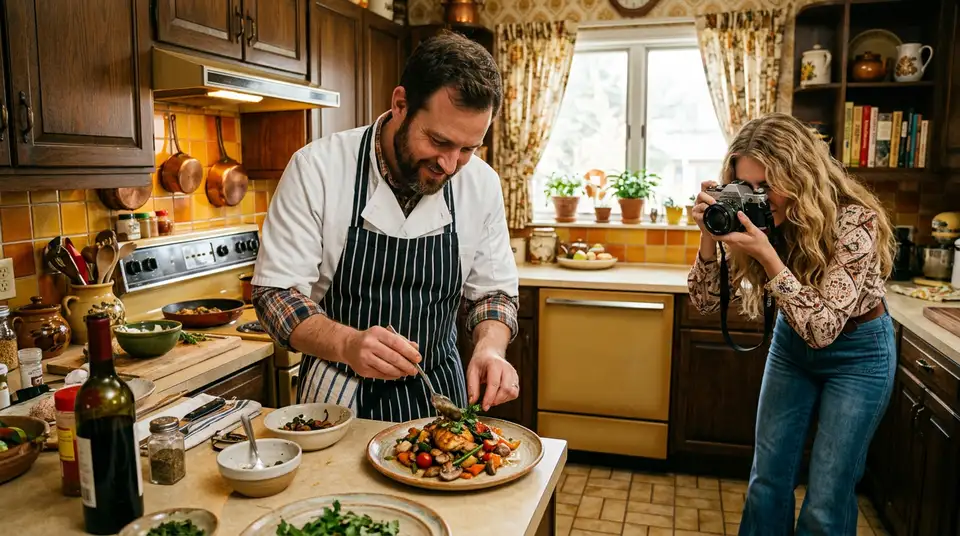
That beautiful risotto your chef plated at 11am during prep? That is content.
The fresh delivery of seasonal produce that arrived this morning? Content.
The bartender testing a new cocktail recipe? Content.
The dining room set up before service with the candles lit? Content.
Your kitchen is a content factory. The problem is not creating content — it is distributing it. And that is exactly what a system solves.
The 10-minute daily loop
Here is the system. One action triggers four channels. Total daily time commitment: 10 minutes.
Step 1: Snap one photo during prep (2 minutes)
Between 10am and noon, while the kitchen is prepping, take one photo. Just one. It does not need to be professional. It does not need a ring light. A well-lit shot of today’s special, a close-up of an ingredient, a behind-the-scenes moment.
Use your phone. Natural light from a window is perfect. Spend 30 seconds making it look decent. Done.
Step 2: Upload to your website’s daily special page (3 minutes)
Your website has a simple “Today’s Special” section. You open it, upload the photo, type two lines about the dish, and hit publish.
This is your owned platform — the one you control completely. Not Instagram’s algorithm deciding who sees it. Not Google’s ad auction. Your website, your content, your rules.
If you have set up your digital menu with QR codes, customers scanning the menu in-house will see this update too. One upload, and your in-house and online presence are both current.
Step 3: Trigger the WhatsApp broadcast (3 minutes)
That same update triggers a WhatsApp message to your contact list. If you have built your customer capture system, you already have a growing list of people who want to hear from you.
The message is simple: a photo of today’s special, a one-line description, and a “Reserve your table” link. Sent at 11am, right when people are starting to think about lunch or making dinner plans.
With a 98% open rate on WhatsApp, nearly everyone on your list sees it. Compare that to an Instagram post where maybe 5% of your followers will ever lay eyes on it.
Step 4: Auto-post to Instagram (2 minutes)
The same photo and caption you used for your website get automatically cross-posted to Instagram. You can use simple scheduling tools to set this up once and forget about it.
Is Instagram still useful? Yes. It is a discovery channel — new customers find you there. But it is not where you build relationships. That happens on your owned channels: your website and your WhatsApp list.
Think of Instagram as the shop window. Your website and WhatsApp are the actual shop.
With the AI layer connected, the same photo gets three different captions automatically — one tuned for the website (SEO-friendly, descriptive), one for WhatsApp (warm, conversational), one for Instagram (short, hashtag-heavy). The workflow reads which dish you photographed, pulls the description from your menu, and drafts each variation in your voice. You skim three captions in 30 seconds and approve. Same 10 minutes total, three properly-tuned messages instead of one copy-pasted everywhere.
The result: one photo, four channels
You took one photo. You spent 10 minutes total. And that single piece of content now lives on:
- Your website (owned, always accessible, SEO-friendly)
- Your WhatsApp list (98% open rate, direct to customers who love you)
- Your Instagram (discovery channel for new customers)
- Your in-house QR menu (visible to every diner currently at a table)
Content shared from owned platforms gets 3 times the engagement of paid ads. That is because it feels real. It is not a polished ad — it is today’s actual food, from your actual kitchen. People can tell the difference.
Why this works when everything else fails
The reason most restaurant marketing fails is that it is treated as a separate activity. Something you do on top of running the restaurant. An extra task on an already impossible list.
This system works because it is not separate from running the restaurant. It is embedded in what you already do.
You already prep food every day. Now you take a photo while you do it.
You already have a website. Now it updates automatically.
You already have customers who love you. Now they hear from you consistently.
The system runs on a single daily trigger — one photo — and everything else flows from it. No content calendar. No brainstorming sessions. No hiring a social media manager. Just one photo during prep, and the system handles distribution.
Building the full machine
This daily loop is the engine, but it runs best when it is connected to the other pieces of your system.
Your owned platform is the foundation
Everything starts with having a website you actually control. Not a Facebook page. Not an Instagram profile. Not a listing on a delivery app. Your own website, where you set the rules and keep the data.
This is the principle behind building on owned ground instead of rented platforms. When you build on Instagram or Uber Eats, you are building on someone else’s land. They can change the rent anytime. Your website is your land.
Your daily special page, your menu, your reservation system, your contact capture — all of it lives on ground you own.
Your menu is a sales engine
Your digital menu is not just a list of dishes. It is the most-viewed page on your website. It is where customers decide what to order and how much to spend.
When your daily loop updates the “Today’s Special” on your website, it also updates what customers see when they scan the QR code at the table. That fresh risotto photo from this morning’s prep? It is now influencing tonight’s orders.
QR codes give you control
Your QR-based menu system is what connects the physical restaurant to the digital system. It is the bridge between the person sitting at table 7 and the marketing machine running in the background.
When a customer scans the QR code, three things happen at once: they see your current menu (with today’s special front and center), they have the option to join your WhatsApp list, and you learn what pages they visit most. That is data you own and can act on.
Customer capture closes the loop
The capture system is what turns a one-time diner into a long-term relationship. The QR code at the table is the entry point. The WhatsApp opt-in is the conversion. And the daily broadcast is what keeps that relationship alive.
Without capture, your daily content reaches new people but loses existing ones. Without the daily loop, your capture system collects contacts but has nothing to send them. The two pieces need each other.
The compound effect
Here is where it gets interesting.
In month one, you have maybe 50 WhatsApp contacts and your daily posts are reaching a small audience. It feels like you are shouting into the void.
By month three, you have 200+ contacts. Your website is getting indexed by Google because it is updated daily (search engines love fresh content). Your Instagram is consistent for the first time ever, and the algorithm is starting to reward you for it.
By month six, you have 500+ contacts. Your WhatsApp broadcasts are filling tables on slow nights. Your Google ranking has climbed because your site has months of consistent, fresh content. Customers are sharing your daily specials with friends. You are spending zero on advertising and your Tuesday nights are busier than they have ever been.
This is the compound effect. Each piece of the system feeds the others. More website content means better Google ranking. Better ranking means more visitors. More visitors means more QR scans. More scans means more WhatsApp contacts. More contacts means more people seeing your daily broadcast. More broadcasts means more repeat visits. More visits means more revenue.
And it all started with one photo during prep.
What you are really building
Let us be honest about what this is.
You are not building a “marketing strategy.” You are building a direct relationship with every person who has ever enjoyed a meal at your restaurant.
You are building independence from platforms that charge you for access to your own customers. Independence from algorithms that decide whether your post gets seen. Independence from delivery apps that take a third of your revenue and put their brand above yours.
You are building a restaurant that does not just make great food — it has a system that turns great food into a growing, loyal customer base. Automatically. In 10 minutes a day.
The food is your product. The system is your business.
Getting started this week
You do not need to build all of this at once. Here is the order that makes the most sense:
Day 1: Set up a “Today’s Special” section on your website. It can be dead simple — a photo, a title, two lines of description.
Day 2-3: Print QR codes for your tables that link to your digital menu. If you do not have a digital menu yet, start with the QR setup guide.
Day 4-5: Set up your WhatsApp Business account and create the opt-in flow from your customer capture system.
Day 6-7: Take your first prep photo. Upload it. Send your first WhatsApp broadcast. Post to Instagram.
Congratulations. The machine is running.
From here, your only job is to take one photo a day during prep. The system does the rest. And every single day, it gets a little more powerful, a little more connected, and a little more valuable.
Ten minutes a day. A restaurant that markets itself. Customers who come back because you stayed in touch, not because you got lucky with an algorithm.
That is what owning your business actually looks like.